Monday, September 23, 2013

Be very, very quiet, we are flying into Long Beach Airport!

Eric Sheng, noise specialist, works in his space over looking the Long Beach Airport as he keeps track of 18 noise monitors place in and around the airport as planes come in and out of the airport in Long Beach CA. on Sept. 3, 2013. Long Beach Airport employs three full-time people to monitor noise levels at and near the runway.
 
(Photo by Thomas R. Cordova - Daily Breeze)        

Once each quarter, JetBlue Airways writes a hefty check to the Friends of the Long Beach Public Library. But the reason is not necessarily altruism.
 
Among major commercial airports, Long Beach Airport is unique in its noise policies. The airport and the city require airplanes to operate unusually quietly — day and night. While cities can no longer enact new noise ordinances under federal law, Long Beach has a long-standing exemption carved out by Congress.

When aircraft operators break the rules, measured at two monitoring stations near the airport, pilots or their employers must pay fees on a per infraction basis. While operators are hit with only a warning on their first transgression, fines can rise up to $300 after that.

JetBlue, the airport’s main commercial tenant, actually pays considerably more, a result of a legal agreement reached between the airline and the city about a decade ago.

The system works by measuring decibel levels. During the day, arriving aircraft must make no more than 101.5 decibels, as measured by a monitoring station near the runway, an airport official said. Departing aircraft can make up to 102.5 decibels. Between 6 and 7 a.m. and between 10 and 11 p.m., the decibel maximum drops to around 90.

In the overnight hours, the decibel limit drops to 79.

Noise violations rarely occur during the day — pilots in modern, efficient aircraft can meet those limits without difficulty — but at other times it is much tricker, aviation experts say.

Between 6 and 7 a.m. and 10 and 11 p.m. some pilots can maneuver aircraft to make them quieter, but in the overnight hours, the limit is nearly impossible to meet, experts say. That means operators have to decide whether to pay the fine or go elsewhere.

Three noise specialists work in the airport operations center tracking decibel levels. Eric Sheng, a noise specialist, monitors flights and take phone calls — sometimes angry ones — from residents. He said the difference between 90 decibels and 100 decibels is considerable and that neighbors tend to know when a violation has occurred.

“A 90 is like a blender in your house and a 100 is like a diesel truck going by your house,” Sheng said. “I think when it goes to 100 it makes a difference. You feel it.”

Most scheduled airlines and charter operators try to avoid rule-breaking. On a recent Wednesday for example, JetBlue’s final arrival was scheduled for 9:17 p.m., a short flight from Sacramento. But occasionally, often due to weather or mechanical difficulties, planes must land later.

According to airport data, JetBlue operated 22 times between 10 and 11 p.m. in June. In 13 of those instances, the carrier’s pilots violated the noise ordinance. Overall, in the first six months of the year, JetBlue had 50 violations. Between January and June, US Airways and UPS were the only other major carriers to have a violation. Each had one.

Overall in June, only about 0.1 percent of all operations (28 of 26,379) resulted in a noise violation, according to airport officials. That number includes private jets.
 
Under municipal law, the city can criminally prosecute the aircraft’s owner and the pilots for breaking the noise ordinance, City Prosecutor Douglas P. Haubert said.
 
“To my knowledge, criminal charges have been filed only three times in the history of the ordinance,” Haubert said in an email.

In 2003, Haubert said, the city and JetBlue reached an agreement that JetBlue would not be prosecuted criminally for noise ordinance violations. In return, the airline would pay more than other operators for each transgression.

In 2011, JetBlue paid $555,000 to the Long Beach Public Library foundation, according to a recent internal airline report. The agreement, called a consent decree, must be renewed every year, but Haubert said he expects it will continue for the foreseeable future.

Other Long Beach operators pay relatively little in fines, but that does not mean the noise rules do not affect operations, especially for private jet companies. Their clients often want to fly at night or in the early morning. But generally, the passengers must go elsewhere, like Los Angeles International Airport or Van Nuys Airport.

“We hold a policy that if you are going to land after 10 p.m. don’t land, go somewhere else,” said Damon Danneker, director of operations at Long Beach Airport-based charter operator JFI Jets. “It hurts business sometimes. Two nights ago one of our rich and famous people wanted to go to Florida but due to noise constraints we had to pass on the business.”

Danneker said most jets can land and take off between 10 and 11 p.m. and 6 and 7 a.m. without breaking the decibel limits, but he said pilots can be reluctant to try.

While the first noise infraction carries only a warning, future mistakes can cost operators and pilots.
 
“Nobody in aviation wants to break a rule ever,” Danneker said. “When you do break those rules, it’s kind of a badge of dishonor.”

Kerry Gerot, spokeswoman for Long Beach Airport, said first-time offenders usually take the transgression seriously.
 
“They get a warning letter and generally they do their best to comply,” she said. “It’s really a matter of education. It’s our job to help educate them especially if it’s a new pilot.”

Not every type of plane is covered by the noise limits, however. Gerot said government jets are exempt, and they can use the airport whenever they want.
 
Thomas Landefeld, who lives in Long Beach about two miles west of the airport, called military jets a major inconvenience. He said planes such as the F-18 are considerably louder than commercial jets.

“The regular carriers, we hear some, but it’s not that annoying,” Landefeld said. “The ones we have heard lately, especially on the weekends, are the military-type jets. If you’re talking, you can hardly hear the person you are talking to. It almost eliminates conversation.”

But Gerot said most residents, once they learn of military training flights, are generally OK with them.
 
“It’s a very small percentage that complains about them,” she said.

  (Brian Sumers - Daily Breeze)

Friday, September 20, 2013

Allegiant Air grounds 30 MD-80s for emergency slide inspections

Allegiant Airlines took more than half of its fleet of MD-80 aircraft out of service Friday to inspect emergency slides, four days after passengers and crew members deployed the devices to escape to the tarmac when smoke was reported on an Allegiant plane in Las Vegas.
 
Las Vegas-based Allegiant Travel Co., parent company of the airline, issued a statement saying Friday's inspections were linked to an unspecified "compliance issue" found during a follow-up review of Monday's evacuation at McCarran International Airport.
 
"All of the slides on the aircraft involved in the evacuation Monday were up-to-date and compliant," company spokeswoman Jessica Wheeler said in an email. "However, that event triggered a maintenance review which found issues with other slides in our fleet."
 
No injuries were reported among the 144 passengers and six crew members who used slides to evacuate an Allegiant aircraft before takeoff for Peoria, Ill. The inspection action covers 30 of the airline's 52 MD-80s.
 
In the statement, company President Andrew Levy apologized for disruption to travelers and promised around-the-clock work to ensure aircraft safety. The airline said delays, rescheduling and cancelations were expected during the next several days, and that inspections were expected to be completed by the end of September.
 
FAA official Ian Gregor in Hawthorne, Calif., said the agency was checking Allegiant's compliance with door slide inspection requirements.
 
Allegiant serves about 100 mostly small cities and vacation destinations including Orlando, Fla., Las Vegas and the Phoenix area. It carried nearly 2.3 passengers to McCarran airport in 2012.
 
McCarran spokesman Chris Jones reported little disruption Friday at the Las Vegas airport, and said staff was monitoring travelers to ensure orderly lines if necessary. He said it was up to Allegiant to accommodate travelers whose Sin City vacations may be extended.
 
Allegiant announced last month that it was adding service to 10 airports including two near New York City.

 (Ken Ritter - Associated Press)

Thursday, September 19, 2013

Sad news here in Long Beach as Boeing announces closure of C-17A production in 2015

C-17A (P-218) 10-0218 rotates from Rwy 30 at Long Beach Airport (LGB/KLGB) on September 6, 2012 as it departs on a pre-delivery test flight.
 
(Photo by Michael Carter)

The C-17 Globemaster III plant, California’s last remaining aircraft manufacturing facility, will shutter in two years, affecting 2,200 Boeing Co. employees based in Long Beach and Huntington Beach and thousands of workers and suppliers nationwide, company officials announced Wednesday.

In an “all-hands-on-deck” meeting before noon, about 3,000 C-17 workers in East Long Beach, Macon, Ga., Mesa, Ariz., El Paso, Texas, and St. Louis, were told in person or via webcast by top Boeing officials that the plant will close after the delivery of the last C-17 in 2015.

“Ending C-17 production was a very difficult but necessary decision,” said Dennis Muilenburg, president and chief executive officer of Boeing Defense, Space & Security.

“We want to thank the highly skilled and talented employees who have built this great airlifter for more than two decades and those who will help us as we continue to build the remaining 22 aircraft and support and modernize the global fleet for decades to come.”

The announcement comes nearly one week after Boeing handed over its 223rd and final C-17 to the Air Force in Charleston, S.C.

The decision to shutter the C-17 program was realized by Boeing officials around the same time of the last delivery to the Air Force, though the company had been considering the decision to end production for a long time, Nan Bouchard, Boeing vice president and C-17 program manager, told reporters in a conference call Wednesday afternoon.

Los Angeles County Supervisor Don Knabe, who was at last week’s delivery in Long Beach, said he was “outraged” to learn about the closure and added he will continue to lobby national leaders in Washington, D.C.

“The C-17 program has been synonymous with Long Beach for years and has been an economic stimulus for Los Angeles County, employing thousands of workers,” Knabe said. “With a local economy that remains sluggish and the unemployment rate stagnant at 9.2 percent, now is not the time for Boeing and the federal government to pull the rug out from underneath us and put more people out of work.
 
“The closure of Boeing’s Long Beach plant means local jobs will be lost and our region’s economic recovery will take yet another significant blow. But the impact of the closure extends far beyond Los Angeles County.”

Despite strong international interest, Boeing did not receive enough orders to protect the C-17 production line beyond 2015, Bouchard said, adding that 13 of the 22 remaining aircraft had no committed orders.

Seven of the orders are bound for India and two will be delivered to a not-yet-named international customer.

The “tough budget environment” faced by its international customers and issues involving U.S. sequestration — the automatic, across-the-board reductions triggered in March when lawmakers failed to agree on the nation’s budget — were uncertainties that led to some “difficult decisions,” Bouchard said.

Created in the late Cold War-era of the 1980s, the C-17 has evolved from fledging prototype to a military workhorse known for its ability to land and take off from short airfields and clocking more than 2.6 million flying hours in various peacekeeping and humanitarian missions.

But when the U.S. government stopped ordering C-17s, Boeing officials began seeking more foreign orders to keep the production line open.

Officials were optimistic, delivering 34 of its 257 C-17s to countries such as Australia, Canada, Qatar, the United Arab Emirates the United Kingdom, the 12-member Strategic Airlift Capability initiative of NATO and Partnership for Peace nations and India, its largest foreign customer.

But industry observers have wondered how much longer the Boeing program would survive without its bread-and-butter customer, the U.S. government.

“The C-17 is by far the best strategic airlifter that has ever been built, but trying to keep a plant running with sales only to foreigners is a tough job,” said aerospace analyst Loren Thompson, of the Lexington Institute, a Virginia think tank.

Currently, 20,000 people between Long Beach and all of its more than 650 suppliers in 44 states owe their employment to the C-17 program, Bouchard said.
A reduction in the workforce will begin in early 2014 and will be done in stages, with the bulk of the reductions occurring in mid-2014 until the last aircraft moves through the facility, Bouchard said.
 
“We recognize how closing the C-17 line will affect the lives of the men and women who work here, and we will do everything possible to assist our employees, their families and our community,” Bouchard said.

That assistance will range from providing financial counseling as well as resume and retirement help to finding employees work elsewhere in Boeing or outside of the company.

Long Beach Councilwoman Gerrie Schipske, who represents the district that encompasses the C-17 program, said this is an opportunity for other area companies to take very experienced, well-trained Long Beach workers and put them to work in technology and growth-industry jobs.
 
“It’s important to be able to provide new opportunities for these workers while the city of Long Beach has an 11.9 percent unemployment rate as of August … and a 22 percent poverty rate,” Schipske said in a statement.

Bouchard said it is too early to tell what will be done to the facility after the closure, but Boeing does not plan to move a commercial or military production program to the Long Beach site.

Meanwhile, Boeing will continue supporting the international C-17 fleet as part of a sustainment agreement, currently under contract through 2017 with annual options through 2021, Bouchard said.
 
Community leaders and Boeing employees reacted strongly to Wednesday’s news.
 “As work slowed over the last several years, we worked side by side with Boeing to extend the C-17 line for seven additional years,” he said. “There’s a sense of sadness to see the end of an institution, but Boeing has grown its commercial aircraft work and announced an engineering design center over the past few years that solidifies the company’s commitment in Long Beach.”

Meanwhile, many of the employees were caught off guard by the news, said Stan Klemchuk, president of the United Aerospace Workers — Local 148 representing 1,100 Boeing mechanics and other employees.

“This came out of nowhere,” he said, adding that the union was informed 15 minutes before the company made its announcement. “We’re in shock and devastated.”

Klemchuk said the union hoped and was led to believe that Boeing would secure enough small foreign orders to buy the company time to figure out other job-saving alternatives. They had been encouraged by some of the international orders over the years.

“Long Beach is losing good, high-paying jobs with benefits,” he said. “It’s just devastating.”

(Karen Robes Meeks - Long Beach Press Telegram)
 
Facts and figures about the Boeing C-17 Globemaster
 
9 million: parts that make up a C-17

2.6 million: operational flight hours exceeded by the C-17

213,000: total material weight in pounds

164,900: pounds of maximum payload

174: length in feet

169.8: wingspan to winglet tips in feet

120: miles of wiring

55.1: height at tail in feet

600: pounds of paint

3: total aircrew, including two in the cockpit and one loadmaster

0.74 to 0.77: Mach cruise speed

4: number of Pratt & Whitney engines

33: The number of world records set during flight-testing at Edwards Air Force Base, more than any other airlifter in history.

+20,000: number of jobs directly associated with the C-17 program

650: number of C-17 suppliers in 44 states

$5.8 billion: estimated total economic impact of C-17

MORE COOL INFO

* A C-17 can take off from a 7,000-foot airfield, fly 2,400 nautical miles and land on an airfield of 3,000 feet or less.

* A C-17 can carry Army vehicles in two side-by-side rows in its cargo compartment, or an M-1, an Army battle tank.

* A deployment load in a C-17 could include three Stryker infantry-fighting vehicles.

FOREIGN ORDERS: 34

India: 10 (only 3 delivered; 7 to be made in 2013-2014)

Qatar: 4

Australia: 6

United Arab Emirates Air Force: 6

United Kingdom: 8

Canada: 4

The 12-nation Strategic Airlift Capability consortium of NATO and Partnership for eace nations: 3

Kuwait: 2 (**still to be delivered**) 

Source: The Boeing Co.

Wednesday, September 18, 2013

Nike Corporations latest Gulfstream

 
Rolls on Rwy 30 for takeoff.
 
 
The latest Gulfstream to join the NIKE corporations growing fleet is G550 (c/n 5121) N1972N, ex N550PR captured departing Long Beach Airport (LGB/KLGB) on September 18, 2013 bound for Portland-Hillsboro Airport (HIO/KHIO).
 
(Photos by Michael Carter)    

Tuesday, September 17, 2013

More good news for Boeing today

Shares of The Boeing Company surged 3.9% to close at $115.67 on Sep 16, 2013 on the back of twin good news. The probability of the company now winning the $7.64 billion South Korean contract is high while flight test announcements for its 787-9 Dreamliner brought in further cause to cheer.

Given the upper hand over Lockheed Martin Corp. and Eurofighter, Boeing’s economical F-15 Silent Eagle (F-15SE) will likely be the only bid for South Korea's military fighter aircraft contest. Lockheed’s F-35 and Eurofighter’s Typhoon were over budget, thereby missing the eligibility mark. Seoul is looking to replace its aging F-4 and F-5 fighters with the proposed F-15 Silent Eagle.

F-15 Silent Eagle had faced opposition from 15 former South Korean air force chiefs who had filed a petition against selecting the aircraft as they believed it lacked the stealth capabilities of other competing models. However, the defense minister of Korea seems to like Boeing's jets, mainly because of its affordability.

Albeit Lockheed’s F-35 is technically superior, its bloated price has compelled the government to shift their attention to Boeing’s F-15SE. This comes as a pat in the back for Boeing’s cost-effective designs that meet the military needs of cash-strapped governments.

More foreign military sales contracts are also much appreciated in this lukewarm budget environment. With the U.S. Department of Defense implementing budget austerity under the sequester, this multi-billion dollar international deal would act as a definite catalyst to Boeing’s military aircraft division.

On the other hand Boeing’s Commercial Airplane Group has not looked back this year, flying high on the success of the Paris Air Show. The company’s latest incarnation of the 787 airplane – the 787-9 Dreamliner – is all set for its maiden flight this week. Production of the first 787-9 Dreamliner was completed last month.

This new variant exceeds the 787-8 by 20 feet in length. Most importantly, 787-9 will be able to carry 250 to 290 passengers, up 40 passengers than the 787-8. It has a range of 8,000 to 8,500 nautical miles compared to 787-8’s range of 7,650 to 8,200 miles. First delivery of 787-9 is scheduled to take place in mid 2014 to the launch customer Air New Zealand. The average cost of a 787-9 Dreamliner is $249.5 million at list prices.

Boeing is the largest aircraft manufacturer in the world in terms of revenue, orders and deliveries, and one of the largest aerospace and defense contractors besides other defense giants like Lockheed Martin, General Dynamics Corp. and Northrop Grumman Corp. In fact, Boeing’s defense business accounts for approximately half of its top line.

Though the company has had glitches with its 787 mascot with respect to delayed launch or for its battery overheating incidents in Jan 2013, its share price has proven to be shock resistant, surging 52.5% year to date.


(Zaks Investment Research)

Boeing 787-9 "Dreamliner" takes to the skies over Washington

(Boeing)

Boeing's 787-9 Dreamliner aircraft took to the skies Tuesday in a maiden test flight, a larger version of the company's original 787-8 jetliner.

The 787-9 lifted off from Paine Field in Everett, Washington state at 11:02 am local time (1802 GMT). The test flight is expected to last between four and five hours.

The plane is the second member of the Dreamliner family of mid-size, long-haul aircraft, designed to use 20 percent less fuel than other airplanes of their size.

Compared with the 787-8, the 787-9 has a range that is about 600 kilometers (373 miles) longer, at a maximum of 15,750 kilometers (9,787 miles).

It can carry 250-290 passengers, up from 210-250 passengers on the initial Dreamliner, which entered commercial service with All Nippon Airways in October 2011.

(Boeing)

The 787-9 is expected to enter service in mid-2014 with launch customer Air New Zealand.
Scott Hamilton, an analyst based in Seattle, noted that Boeing long has introduced new models of existing aircraft.

"The first flight of the 787-9 ordinarily would be a little consequence," Hamilton said.

"But because of the painful birth of the lead variant, the 787-8, and its troubled early service life that included a three and a half month grounding, the 787-9 will have greater scrutiny to see if Boeing has the program troubles behind it."

The 787-8's development program ran three years behind schedule. All 787s in service in January were grounded worldwide over problems with overheated batteries.

Since the grounding was lifted in late April, there have been a series of problems with customers' planes.

Boeing says the problems are typical for a new aircraft.

To date, Boeing has delivered 84 787-8s to 14 clients and has orders for 852. The Dreamliner's main rival is the A350 of European aircraft maker Airbus.

Shares in Dow member Boeing were up 1.2 percent at $117.11 in late-afternoon trade on the New York Stock Exchange.

(AFP News)

Bombardier CS100 performs first flight

(Bombardier)

Bombardier's new CS100 medium range jetliner took to the skies on its maiden flight on Monday September 16, 2013, marking the Canadian manufacturer's entry into airspace dominated by Airbus and Boeing.

Hundreds of employees and guests cheered as the 100-125 seat passenger jet departed from Mirabel airport in the northwest corner of Montreal for a test flight just before 10 a.m. local time (1400 GMT) under a bright blue sky.

"It's the largest aircraft ever conceived and assembled in Canada," Bombardier engineer Stephane Poitras told AFP. "We're witnessing history today."

For the first time, Bombardier will now be competing directly with the smallest airliners from aerospace giants Airbus and Boeing, a move which Poitras described as a "huge leap" for the company based in Montreal.

Bombardier has already secured 177 firm orders for the narrow-body twin-engine aircraft, which consumes 20 percent less fuel than its competitors, and is scheduled to start deliveries at the end of 2014.

Bombardier chief executive Pierre Beaudoin said he hopes to boost that sales figure to 300 over the coming months.

Bombardier, which previously focused on building regional jets and trains, spent $3.5 billion and 10 years to develop the CS100 and its slightly larger sibling, the CS300, which seats up to 160 passengers and is expected to launch in early 2014.

It first announced the venture in 2004 but shelved its plans two years later when demand for medium-range aircrafts plummeted, and then revived them in 2007 when the market started to rebound.

Sales of the CSeries aircraft should generate between $5 billion and $8 billion in annual revenues for the company, as demand for transcontinental jets is forecast to skyrocket, said Beaudoin.

"That's a huge increase for our company when you consider that our annual revenues average $20 billion," he said.

Indeed Bombardier is taking a huge gamble by going head-to-head with the European and American leaders in aerospace, in their most profitable space.

The CSeries jetliners will likely compete with the Boeing 737, Airbus A318 and A319, and Embraer 195.

But Boeing and Airbus appear unfazed by this new entrant, offering instead congratulations to Bombardier on its CS100's first flight. "Such 'firsts' are great for everyone who loves aviation," Airbus said in a Twitter message.

Just getting to this point has not been easy for Bombardier. The company had to push back its CS100 launch, originally set for the end of 2012, several times.

Beaudoin is confident that Bombardier can not only break in to the market for medium-range jetliners, but brazenly push its way into the pole position.

He said airlines are forecast to order approximately 7,000 jetliners capable of seating up to 150 passengers as they upgrade and expand their aging fleets over the next two decades.

Bombardier, he said, hopes to secure a whopping 3,500 of those orders.

Korean Air, Gulf Air, Air Baltic and Atlas Jet are among the first to place orders with Bombardier.
Many airlines are struggling with soaring fuel costs. Bombardier was able to cut fuel consumption by using composite materials instead of aluminium for the wings.

Nico Buchholz, vice president of Lufthansa, who was on hand for the test flight, commented that the CSeries aircraft's range and fuel efficiency are "nicely adapted for the European market."

For Robert Deluze, head of Canada's Porter Airlines, the CS100's quieter Pratt and Whitney engines are key to his airline's future expansion.

Porter currently flies twin turboprop aircraft out of the downtown Toronto island airport, but its plans to expand and use slightly larger aircraft with jet engines has riled nearby waterfront condo dwellers.

He needed to find a quieter jet that wouldn't bother the neighbours and, he said, the CS100 is "clearly a whisper jet."

(Clement Sabourin - AFP)

Friday, September 13, 2013

Oprah Winfrey's new G550 at Long Beach Airport


Rolling for takeoff on Rwy 30.
 
 
Rotates from Rwy 30 with the Gulfstream Service Center in the distance.
 
Gulfstream G550 (c/n 5416) N540W, ex-N516GA which is operated by Harpo Inc., Oprah Winfrey's company is captured departing Long Beach Airport (LGB/KLGB) on September 13, 2013 following a visit to the Gulfstream facilities here at the airport.
 
(Photos by Michael Carter)

Thursday, September 12, 2013

USAF takes delivery of final C-17A


The USAF took delivery of its final C-17A (P-223) 10-0223 this morning at Long Beach Airport (LGB/KLGB). This last a/c was built to replace the C-17A (P-73) 00-0173 lost at Elmendorf AFB on July 28, 2010.
 
(Photos by Michael Carter)

Tuesday, September 10, 2013

G550 destined for Indian customer flies at Long Beach


Taxies on "Delta" towards a Rwy 30 departure.


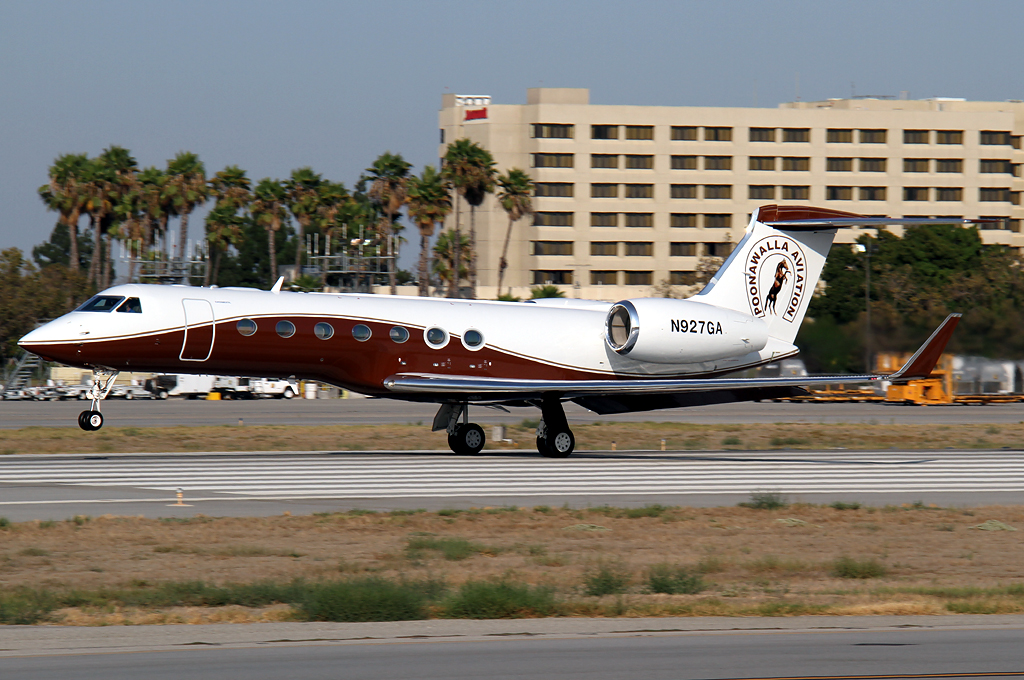
Cool tail logo!
 

Rotates from Rwy 30.
 
 
Positive climb, gear up!
 
G550 (c/n 5427) N927GA tbr VT-CPA departed Long Beach Airport (LGB/KLGB)this evening at 17:06 pst bound for "Shots" on a pre-delivery test flight.
 
(Photos By Michael Carter)

Wednesday, September 4, 2013

Asia-Pacific passenger traffic up, cargo down

International passenger traffic on Asia-Pacific carriers rose 6.6% in July to 19.6 million year-over-year; in June, international passenger traffic grew 7.1% to 18.4 million compared to June 2012.                                                                        The findings are according to traffic results reports released by the Association of Asia Pacific Airlines (AAPA).

In July, international RPKs rose 6.1% and available seat capacity was up 6.2%, resulting in a load factor of 80%, down 0.1 points. In June, international RPKs rose 5.7% and available seat capacity increased 6.4%, resulting in a load factor of 79.6%, down 0.5 point.

July international cargo demand, measured by FTKs, dropped 2.6% from July 2012 levels. June international cargo demand also declined 2.2% year-over-year.

In July, freight capacity expanded 1.8%. In June, freight capacity rose just 0.3%. July’s freight load factor was 64.2%, down 2.9 points year-over-year; June’s freight load factor was 66.2%, down 1.7 points “Continued growth in regional Asian economies maintained positive consumer and business sentiment, and was reflected in passenger demand for both leisure and business related travel,” AAPA DG Andrew Herdman said.

“On the other hand, air freight markets remained weak, with a further 2.4% fall in air freight during the first seven months of the year, as a result of weak demand in Europe and other key export markets.”

(Mark Nensel - ATWOnline News)

Boeing brings 787 training to Miami

Boeing has launched 787 customer training in Miami, Fla., the site of the company's largest commercial aviation training campus. Aeromexico and LAN Airlines are the first two customers to train on the 787 suites at the Boeing Flight Services Miami campus.

Boeing has greatly enhanced its overall training capability in Florida following an announcement in March that the company would relocate training devices from Seattle to Miami.

“To better serve airlines and meet growing personnel training requirements, two 787 full-flight simulators are now located at the Miami campus as well as an additional Next-Generation 737 full-flight simulator and 717, 747 and 767 simulators.

An additional 777 simulator will locate in Miami later this year,” Boeing said in a statement. “These seven devices will bring total capability in Miami to 17 full-flight simulators across airplane types, making the campus one of the largest commercial flight training facilities in the world.”

(Linda Blachly - ATWOnline News)

Work Wraps on Van Nuys Runway Rehab Project

California’s Van Nuys Airport celebrated the completion of a seven-month, $20.5 million renovation on its main runway late last week.


Aerobatic pilot Sean Tucker sliced the ceremonial ribbon with the speeding wing of his Challenger biplane, officially opening the revamped runway to traffic.
 
The modernization project on 8,000-foot Runway 16R, the largest maintenance project at the Los Angeles-area airport in more than 50 years, began in February and included approximately 2,500 hours of construction time spread over 300 days.
 
During this time, the runway was closed entirely for 10 full days and 26 nights, and operated with shortened lengths for an additional 65 days.
 
The improvements include asphalt overlay and partial reconstruction of the runway’s north, center and south sections; installation of a new blast fence at the run-up area; repairs to the existing concrete runway ends; repair and expansion of concrete shoulder pavements; high-speed exit light modifications; new embedded approach lighting; and new pavement markings.
 
The project, which is expected to extend the life of the runway for at least 20 years, was completed on time and on budget, according to airport owner Los Angeles World Airports.
 
(Air International News)
 

AirTran flight attendants come to tentative agreement with Southwest Airlines

Southwest Airlines has reached a tentative collective bargaining agreement with flight attendants of AirTran Airways, a wholly owned subsidiary of Southwest Airlines. AirTran flight attendants are represented by the Association of Flight Attendants. The agreement, which became amendable in May, requires membership ratification.

The parties have been in discussions since February on an agreement that would serve as a bridge for the AirTran flight attendants until they ultimately transition to Southwest. To date, more than 400 flight attendants have made the transition, while approximately 1,700 flight attendants remain in the AirTran partition. 

Southwest Airlines finalized closing of the acquisition of AirTran Holdings on May 2, 2011.

(Linda Blachly - ATWOnline News)

New Bombardier CSeries may make first flight this weekend

Canada's all-new Bombardier CSeries passenger jet is being readied for a long-awaited maiden flight as early this weekend, possibly on Sunday, two industry sources said.

As with all such debuts, the exact timing remains unclear as crew carry out final tests and look for the weather needed to fly the first all-new airliner in its 100- to 149-seat category for decades.

But the sources, who spoke on condition of anonymity because they are not authorized to speak publicly, said the delayed debut could be just days away barring further glitches.

"There is a high chance that you will have some flight news this weekend, most probably on Sunday (September 8)," one industry source said.

Given the stakes involved, it would not however be a surprise if the schedule slipped again by a few days, the sources said.

The debut, marking Canada's attempt to break into a market dominated by Airbus and Boeing, edged closer on Wednesday when pilots were due to start high-speed taxi trials.

But a Bombardier spokeswoman declined to comment on the timing of the maiden flight to be held in Mirabel, Quebec.

The first flight will be the culmination of a five-year, 3.4-billion development program for the CSeries.

Montreal-based Bombardier says the aircraft will be lighter and more efficient than other aircraft in the same category.

Airbus and Boeing have hit back by putting new engines on their best-selling narrowbody A320 and Boeing 737 models.

Bombardier has delayed the new aircraft's maiden flight three times. It said on Friday, however, it had received a flight test permit from industry regulator Transport Canada.

A source familiar with the situation said on Friday the CSeries was poised to fly before September 17, when the company is hosting an event to celebrate the maiden voyage.

Test pilots and other experts say the exact date of a debut depends on the results of the high-speed taxi tests, landing gear tests and emergency braking, as well as weather conditions.

The next few months of flight testing are seen as crucial, test not only for Bombardier but also its engine maker Pratt & Whitney, a unit of United Technologies.

The aircraft is powered by a brand-new generation of fuel-saving engines called Geared Turbofan (GTF), which have generated billions of dollars of other aircraft sales worldwide. Their performance could have implications across the industry.

Their debut on the CSeries will be closely watched by Airbus which has adopted similar Pratt engines for some of its best-selling A320 jets from 2015, as well as CFM International, Pratt's main competitor in the cut-throat engine market.

CFM, jointly owned by General Electric and France's Safran, has developed its own new model of engines called LEAP that will power future Chinese passenger jets as well as all Boeing narrowbody and some Airbus jets.

(Reuters)

Delta chooses Airbus over Boeing

**When your trying to save a buck "You get what you pay for!"
Michael Carter.....Editor Aero Pacific Flightlines

Delta Air Lines Inc. announced an order for Airbus jets on Wednesday worth almost $6 billion at list prices, softening its reliance on Boeing for the first time in two decades as it looks for plane bargains.

The order, crowning a months-long competition between the transatlantic plane-making rivals, includes 30 A321 narrowbody planes to be used on domestic flying as well as 10 A330-300 widebody aircraft for international routes. Deliveries will be between 2015 and 2017.

The list price for the deal is $5.6 billion, but analysts said Delta may have won a steep discount after holding out longer than most of its rivals for lower prices as Europe's Airbus seeks to expand recent successes in Boeing's home market.

"I would be surprised if Delta didn't get a phenomenally good deal," said Adam Pilarski, senior vice president at U.S.-based aviation consultants Avitas.

Both the aircraft types and the delivery schedule - between 2015 and 2017 when both major plane makers are keen to keep up production of existing models before switching to new variants - underscores the probability of competitive pricing, he said.

Airbus sales chief John Leahy said competition for the deal had been tough but denied the price was abnormally low.

"This was a competitive price, but I don't believe it was any different from normal. We don't talk about detailed pricing," he told Reuters in a telephone interview.

Delta declined to comment on pricing but said it also considered the 777-300 and 737-900ER models from Boeing in its decision. Boeing said it had tried to secure a deal that made sense for Delta and itself.

Shares of Delta closed up 2.4 percent at $20.31.

In Paris, Airbus parent EADS rose almost one percent, outperforming a fractionally firmer blue-chip index.

OWNERSHIP COSTS

Atlanta-based Delta operates Boeing and Airbus aircraft. The latest deal is the first major Airbus order under the Delta brand since the 2008 acquisition of Northwest.

However, Delta has yet to join an industry-wide stampede for a new generation of narrowbody jets with fuel-saving engines due to enter service from the middle of the decade.

Its executives say they prefer to keep a lid on aircraft ownership costs and manage exposure to high fuel prices partly through its own recently acquired oil refinery.

Delta, which earlier this year restarted a dividend and launched a share buyback, said the Airbus planes will help it improve return on invested capital from the time they go into service.

Chief Executive Richard Anderson told Reuters in May that Delta would wait for the upcoming generation of revamped jets to prove themselves before ordering any.

Analysts say Airbus and Boeing are, meanwhile, offering attractive end-of-the-line prices for the corresponding existing models such as the "A321ceo," which seats around 190 people.

In 2011, Delta ordered 100 similar Boeing 737-900 extended range models due to be delivered starting later this year.

The current A321 sells for $104 million at list prices, about 9 percent less than its re-engined version due to enter service from late 2015. The jet is part of the European manufacturer's A320 family that competes with the Boeing 737.

In practice, jet aircraft typically sell for about half their catalog value for favored clients, analysts say.

Like the A321, the larger long-haul A330 is also part of Airbus's existing portfolio, competing on price and availability with Boeing's modern carbon-composite 787 Dreamliner.

More than three years of delays getting the 787 into service allowed Airbus to improve the A330, analyst Scott Hamilton, of Leeham Co, said in a review of Delta's fleet purchases.

The expectation of the 787 killing the A330 "hasn't worked out," he said.

Delta has deferred its delivery of the 18 787s it has on order to 2020-2022. Those jets were ordered in 2005 by Northwest Airlines before it merged with Delta.

Barclays analyst Carter Copeland said he didn't see Delta's Airbus order as a "any particular big blow" for the 787 or the revamped 737, both of which have sizable backlogs.

 (Karen Jacobs - Reuters)

787 a game changer for Norwegian Air

Norwegian Air 787-8 (35304/102) EI-LNA.
(Photo by James Mepsted) 

http://finance.yahoo.com/video/norwegian-airs-boeing-revolution-201236111.html
 

Tuesday, September 3, 2013

Norwegian Air Shuttle announces new Los Angeles (LAX) service

Budget airline Norwegian Air Shuttle plans to set up bases in New York and Fort Lauderdale next year and will significantly increase services between the Nordics and the US as it receives more Boeing 787 "Dreamliners."

Norwegian, the first budget airline in recent years to offer transatlantic services, will fly to Los Angeles, San Francisco and Orlando in addition to its routes to Fort Lauderdale and New York, chief executive Bjoern Kjos told a news conference on Tuesday.

Norwegian placed Europe's biggest aircraft order last year, 222 planes from Boeing and Airbus. It has been one of Europe's most successful carriers, taking market share from SAS and also moving outside its traditional Nordic market with bases in London and Spain.

It is also one of the most successful stocks on the Oslo bourse with its shares up 105 percent over the past 12 months.

Still, many analysts consider the stock undervalued as it is trading at 7.8 times its expected 2014 earnings, well below an average of around 10 for European peers.

Norwegian launched long-haul services earlier this year when it received the first of eight 787s, and it has recorded a 96 percent load factor on those flights.

The firm says it can operate long-haul flights 30 percent cheaper than traditional airlines, primarily because of the 787's lower operating cost.

(Reuters)

British Airways to begin London-Heathrow / Austin, Texas with 787 "Dreamliner"

When Boeing began shopping its new 787 Dreamliner around to potential customers a decade ago, it became clear very quickly to airline executives that the jet’s lower operating economics would allow for all sorts of new routes existing planes can’t fly cost effectively.

With its combination of long-haul range and modest seat capacity—not too big, not too small—the 787 could connect far-flung destinations that had traditionally required a stop in a hub.

Now, those new routes are becoming reality. British Airways plans to begin flying a 787 from London Heathrow to Austin in March, its third Texas destination, while low-cost carrier Norwegian Air Shuttle will begin using the plane on new flights from Scandinavia to California in March.

Stockholm-Los Angeles will be the first route, followed by Oslo and Copenhagen flights to the second-largest U.S. city. Norwegian will also use the 787 on new flights in May from Oslo and Stockholm to Oakland, CA.

Austin’s rising importance the city now hosts several tech heavyweights such as Dell, Apple, Google, IBM and eBay, along with several major cultural events year-round—made it an appealing addition to British Airways’ roster of 20 U.S. destinations, said Simon Brooks, BA’s senior vice president for North American sales.

He declined to discuss whether the airline is getting any type of incentives from Austin for the route, which will have daily flights in May, up from five per week initially. Airport officials did not return calls seeking comment.

United, the first U.S. airline to fly the plane, has begun service between its Denver and Tokyo hubs, a pairing that CEO Jeff Smisek says was possible only because of the plane. “If we flew the 777 on that route, we’d have our head handed to us,” Smisek told the Denver Post last year.

“In terms of costs, it would never be worth it.” United also is flying the 787 from Houston to Lagos, Nigeria, the first time the two crude oil centers have been linked by a nonstop flight.

 (Justin Bachman - Bloomberg Business Week)

Gulfstream growth defies business climate

This was run last week on local Savannah, GA. TV Station WTOC-TV 11.
I hope you enjoy it as much as I did.......Michael.
 
 
Gulfstream G550 (c/n 5121) N1972N, ex-N550PR in the Gulfstream paint shop at Long Beach Airport (LGB/KLGB) on August 30, 2013.
(Photo by Michael Carter)  

Gulfstream growth defies business climate - WTOC-TV: Savannah, Beaufort, SC, News, Weather & Sports