Tuesday, February 16, 2016

Viking Promotes New Twin Otter S Series

British Columbia, Canada-based Viking Air is expanding its line of the popular Series 400 Twin Otter with a dedicated seaplane version, which the company says is the first ever to be offered in the 15- to 19-passenger category. Named the 400S, the seaplane derivative is offered (for now) with non-amphibious “straight” floats only. It will carry a list price less than $6 million, with first deliveries set for the first quarter of 2017.

A Viking Twin Otter (on wheels) is here at the Singapore Airshow static display, and the company is hoping for more orders from Asian customers. Malaysia Airlines subsidiary MASwings, for example, is operating Twin Otters, as well as Indonesia's Airfast. The twin turboprop has long been offered in numerous versions for conventional commercial passenger service as well as mountain flying (including with skis), cargo, parachuting, special mission operations and on Wipline aluminum amphibious floats.

The 400S seaplane version will feature new-generation composite straight floats (manufacturer still to be determined); the Honeywell “Super-Lite” integrated digital avionics suite adapted for VFR (visual flight rules) operations; a standard 17-passenger seating configuration; and Pratt & Whitney Canada PT6A-27 engines incorporating platinum-coated CT propeller blades.

Available upgrades include IFR (instrument flight rules) avionics; 19-passenger configuration; and a 15-seat/cargo combi configuration. Amphibious versions of the composite floats are planned for the future. Viking said that the 400S is adapted for quick turn-around cycles and can achieve a break-even load factor of around eight passengers under typical operating conditions.

Viking is introducing corrosion-resistant packages on the 400S for the airframe, power-plant and fuel system, along with additional draining, sealing and prevalent use of corrosion-resistant material throughout the aircraft. These extra measures are taken to allow the Viking 400S to operate in extreme marine environments while reducing maintenance costs and downtime.

Viking obtained the de Havilland Canada Twin Otter type certificate and restarted production in 2010. Powered by a pair of Pratt & Whitney Canada PT6A-34 engines, the $7 million aircraft can seat up to 19 passengers and features Honeywell Primus Apex avionics. Viking also supports the De Havilland legacy fleet.

(Jennifer Meszaros - AINOnline News)

Ethiopian Airlines Prepares To Launch Private Jet Service

Ethiopian Airlines is preparing to launch private jet services for passengers traveling between the Ethiopian capital Addis Ababa and other African cities. The scheduled operator, which is part of the Star Alliance, is currently working on a feasibility study for a new division called ET Executive.

It has yet to specify which aircraft types it would use for the flights, but CEO Tewolde Gebremariam stated that he expects to have a requirement for jets seating between 10 and 20 passengers.

Also still to be determined are the terms under which the flights would be offered and whether they would operate on a scheduled or ad hoc charter basis. “We hope to finalize the business plan in the near future,” Gebremariam said.

Addis Ababa is the headquarters for the African Union, which is a significant generator of airline traffic. Ethiopian Airlines currently has a fleet of 76 aircraft, most of them Boeings. It has 42 more aircraft on order, among them 14 Airbus A350-900s.

(Kaleyesus Bekele - AINOnline News)

JetSuite Launches Cuba Charter Service

JetSuite Embraer EMB-500 Phenom 100 (c/n 50000183) N586JS on short final to Rwy 30 at Long Beach Airport (LGB/KLGB) on September 6, 2015.
(Photo by Michael Carter)

Travelers with permission to travel to Cuba can now charter a JetSuite CJ3 or Phenom 100 and fly nonstop to Havana from 16 gateway airports in the U.S.

One-way prices for the trip (50K JetSuite members) range from $11,152 to $23,675, depending on the departure airport. 

“Our mission continues to revolve around making private air travel accessible to more people than ever before, and offering an unprecedented level of transparency,” said JetSuite CEO Alex Wilcox.
 
“We are thrilled to expand our service to Cuba, a destination I know our clients will be eager to explore.”

Passengers are required to secure permission to travel to Cuba according to 31 CFR § 515.560.

Among the valid reasons are official U.S., foreign or nongovernmental organization business; journalistic activity; professional research and meetings; educational or religious activities; public performances, clinics, workshops, athletic and other competitions, and exhibitions; support for the Cuban people; and humanitarian projects. Tourism is not considered a valid reason.

(Matt Thurber - AINOnline News)

United Airlines mechanics could be about to go on strike

Maintenance workers at United Airlines overwhelmingly rejected a new contract offer, their union said Tuesday, adding it will seek approval from U.S. regulators to strike.

More than 93 percent of mechanics who voted decided against the company's offer, the International Brotherhood of Teamsters said in a news release. The union said it will petition the U.S. National Mediation Board for the go-ahead to strike.

It was not immediately clear if a strike was likely or how long it would take the union to request the action.

The vote marks a setback in United's years-long effort to reach a joint deal with the technicians. It has yet to conclude a contract covering maintenance workers from both United and Continental since the carriers merged in 2010.

"At a time when United Airlines is incredibly profitable, it is clear that mechanics deserve a better offer from the company," Jim Hoffa, Teamsters General President, said in the statement.

Chicago-based United more than doubled its adjusted fourth-quarter profit from a year ago to $934 million. Its contract offer provided for an immediate 25-percent raise and bonus checks averaging $9,000, though the Teamsters expressed concern regarding wages for incoming mechanics.

"Although we are disappointed by this outcome we are eager to get right back to the table," said Oscar Munoz, chief executive of parent United Continental Holdings Inc, in a post on a public company website that is focused on labor talks.

Munoz has made boosting workers' morale a priority since taking on the airline's top job in September.

United and the Teamsters paused talks in October after rival American Airlines Group Inc announced a wage hike, resetting what they considered was an acceptable offer.

(Sudarshan Varadhan in Bengaluru and Jeffrey Dastin  - Business Insider)

Commercial air taffic to resume between the United States and Cuba!

The United States and Cuba signed an agreement on Tuesday morning to resume commercial air traffic for the first time in five decades, starting the clock on dozens of new flights operating daily by next fall.

U.S. Transportation Secretary Anthony Foxx and Cuban Transportation Minister Adel Yzquierdo Rodriguez signed the deal in a ceremony at Havana's Hotel Nacional.

U.S. airlines can now start bidding on routes for as many as 110 U.S.-Cuba flights a day - more than five times the current number. All flights operating between the two countries today are charters.

The agreement allows 20 regular daily U.S. flights to Havana, in addition to the current 10-15 charter flights a day. The rest would be to other Cuban cities.

"Today is a historic day in the relationship between Cuba and the U.S.," said Foxx. "It represents a critically important milestone in the U.S. effort to engage with Cuba."

Yzquierdo Rodriguez said "the adoption of this memorandum is an important step that will soon permit the establishment of regular flights between the United States and Cuba."

Barring other major announcements, the restart of commercial flights will be the most significant development in U.S.-Cuba trade since Presidents Barack Obama and Raul Castro announced in late 2014 that they would begin normalizing ties after a half-century of Cold War opposition.

The Obama administration is eager to make rapid progress on building trade and diplomatic ties with Cuba before the president leaves office. The coming weeks are seen as particularly crucial to building momentum ahead of a trip he hopes to make to Havana by the end of March.

Nearly 160,000 U.S. leisure travelers flew to Cuba last year, along with hundreds of thousands of Cuban-Americans visiting family, mostly on expensive, frequently chaotic charter flights out of Florida.

Commercial flights could bring hundreds of thousands more U.S. travelers a year and make the travel process far easier, with features such as online booking and 24-hour customer service that are largely absent in the charter industry.

U.S. visitors to Cuba will still have to qualify under one of the travel categories legally authorized by the U.S. government. Tourism is still barred by law, but the number of legal reasons to go to Cuba - from organizing professional meetings to distributing information to Cubans - has grown so large and loosely enforced that the distinction from tourism has blurred significantly.

Commercial travel will give travelers the ability to simply check an online box on a long list of authorized categories.

The deal does not contemplate flights by Cuba's national airline to the United States, where lawyers for families and businesses that have sued Havana over decades-old property confiscations are eager to freeze any of its assets that they can get their hands on.

Tuesday's announcement will open a 15-day window for U.S. airlines to request rights to the new Cuba routes. U.S. carriers would then have to strike deals with Cuban aviation officials, a process the U.S. hopes will be complete by the fall.

A number of U.S. carriers said they would bid on Cuba flights, in many cases without revealing the specific routes they will seek.

American Airlines spokesman Matt Miller said the company plans to bid on routes from Miami and other unspecified "American hubs."

The carrier has been operating U.S.-Cuba charter flights since April 1991, the longest of any U.S. airline, and currently offers 22 weekly flights out of Miami to Havana, Camaguey, Cienfuegos, Holguin and Santa Clara. American also flies from Tampa to Havana and Holguin, and between Los Angeles and Havana.

United Airlines is also looking to serve Havana from some of its hubs, spokesman Luke Punzenberger said. The carrier's major hubs include Chicago, Houston, Washington and Newark, New Jersey. It currently does not fly charters to Cuba.

JetBlue Airways said it was eager to offer service between "multiple" cities in the United States and the island, with spokesman Doug McGraw saying that "interest in Cuba has reached levels not seen for a generation." The carrier currently flies charters to various Cuban destinations out of New York, Tampa and Fort Lauderdale.

Discount carrier Spirit Airlines spokesman Paul Berry said it, too, plans to submit a proposal. Spirit's largest operation is out of Fort Lauderdale, accounting for 15 percent of its flights.

Southwest Airlines also expressed interest in flights to Cuba.

Delta Air Lines spokesman Anthony Black said the carrier plans to at least apply for flights from its Atlanta hub to Havana.

CBS MoneyWatch reported that other American travel companies are edging into Cuba. Cruise operator Carnival plans seven-night tours to the island starting this year.

(CBS News)

Boeing says 787 production will ramp to 12 per month by summer

LAN Boeing 787-8 "Dreamliner" (38466/74) CC-BBB climbs from Rwy 25R at Los Angeles International Airport (LAX/KLAX) on February 2, 2016.
(Photo by Michael Carter)

Boeing is ramping up total production of its wide-body 787 Dreamliner to 12 planes a month from ten, Beverly Wyse, vice president and general manager of Boeing South Carolina said Tuesday.

Boeing delivered the 100th 787 Dreamliner wide-body commercial jet from its South Carolina plant to American Airlines on Tuesday. 

American now has 14 787-8s, all on international routes, said Terri Pope, Charlotte hub manager. This autumn, it will take delivery of its first 787-9, a larger version of the original Dreamliner, she said. It has ordered 22 of those, she said.

Boeing's South Carolina plant delivered its first 787 in October 2012. "We'll do the next hundred in half the time," Wyse said.

South Carolina builds about three complete 787s a month. The planes are also built in Everett, Washington.
Boeing plans to boost total 787 production to 12 planes a month before the middle of the summer, a spokeswoman said.

Wyse said she does not anticipate reducing the number of direct Boeing employees at the South Carolina plant.
 
"On a per airplane basis, our employee base will come down but we cover that with natural attrition and having temporary workers, contract workers," Wyse said, adding that she could not completely rule out layoffs.

The South Carolina plant will be the exclusive builder of the newest "stretch" version, the 787-10, which Boeing calls the "Dash 10." Design work for the 787-10 is complete, first flights will take place next year, and first deliveries will be in 2018, Wyse said.

(Harriet McLeod - Reuters)

Why You'll Have to Wait Years Before Getting That Gulfstream Personal Jet

A brand new Gulfstream G650 (c/n 6182) N682GA arrives at Long Beach Airport (LGB/KLGB) from the Gulfstream factory at Savannah-Hilton Head International Airport (SAV/KSAV) on February 3, 2016.
(Photo by Michael Carter)

Gulfstream Aerospace Corp. says it’s unable to keep up with demand from the rich.
 
Pay $65 million for the G650 or G650ER personal jets, and your wait to board them could be as long as two years, Scott Neal, Gulfstream’s senior vice president of worldwide sales and marketing, said in a Bloomberg TV interview Tuesday at the Singapore Air Show.
 
The G650ER "has taken market share at the top end of the market. It’s really created a new market to itself," Neal said. "The next available delivery for a new G650 or G650ER is a little over two years from now."
 
Savannah, Georgia-based Gulfstream is seeing such strong demand for its personal jets from corporations and chief executives that the General Dynamics Corp. unit is looking to increase production of planes in the G650 family, Neal said.

Gulfstream is grabbing share from rivals with its flagship large-cabin aircraft as the market becomes more receptive to the usefulness of a private aircraft in running a business.
 
Receptive Market
 
"We have seen a real shift to people understanding that business aircraft are truly for business," Neal said. "Large companies and private individuals can’t do what they do without the benefit of a corporate aircraft."
 
Millionaires in search of new toys are set to fuel a fourfold jump in Asia’s share of private jets in the next five years, according to a 2013 forecast by aviation consultant Jetsolution International Services Ltd.

Asians may own as much as 20 percent of the global luxury jet fleet by 2017 as economic growth spawns new millionaires. Southeast Asia will create the next wave of demand for private aircraft, benefiting Gulfstream, Embraer SA and Textron Inc.’s Cessna, the aviation consultant said.
 
Asia Pacific is already Gulfstream’s second-biggest market and "will continue to grow," Neal said. "But it will be some time before it overtakes the U.S. I couldn’t predict when."
 
The G650 family has a range of about 13,000 kilometers (8,080 miles), sleeps as many as 10 people and can cruise as high as 51,000 feet. Gulfstream delivered about 150 planes last year and is expanding its maintenance support network, he said.
 
The plane can fit 18 passengers in its 8.5-foot-wide cabin, according to the website.
 
A longer, wider cabin and a choice of 12 floor plans offer more design configurations for meetings, entertaining and relaxing, the company says. A convection oven, large ice drawers and fitted storage for flatware and crystal enhance the dining options, according to the company.
 

What Is JetBlue's Plan in Long Beach?

jetBlue Airbus A320-232 (c/n 1546) N526JL "Blues Just Want to Have Fun" arrives at Long Beach Airport (LGB/KLGB) on March 10, 2011.
(Photo by Michael Carter) 

JetBlue's focus city operation at Long Beach Airport has languished for years.

In 2001, less than two years after its first flight, New York-based airline JetBlue Airways decided to set up a West Coast focus city in Long Beach, just outside of Los Angeles.
 
Long Beach Airport is unusual because it has a very restrictive noise ordinance that limits the number of commercial airline flights permitted there. JetBlue has taken advantage of this situation to maintain a dominant share of traffic at Long Beach Airport for more than a decade.
 
However, JetBlue has dialed back its service in Long Beach in recent years.

Meanwhile, it is about to face a bit of new competition there from Southwest Airlines. Yet it still talks about Long Beach as a potential growth market. What is JetBlue's plan?
 
A shifting relationship

JetBlue grew rapidly in Long Beach in the first few years after it entered the market in 2001. Thanks to its customer-friendly policies and the appeal of an uncrowded airport, JetBlue built up a loyal customer base in the Long Beach area. Meanwhile, the noise ordinance protected it from direct competition, as other airlines were unable to add flights there.
 
Solid flight demand and low competition made Long Beach a nicely profitable market for JetBlue -- for a while. However, beginning around 2005, rising oil prices caused JetBlue to cut back on long-haul service there in favor of shorter flights, often using its smaller E190 planes.
 
The arrival of Virgin America at Los Angeles International Airport (LAX) in 2007 added further pressure. Virgin America quickly began flying to many of the same cities that JetBlue served from Long Beach. With its stylish service and low fares, Virgin America began to lure travelers back to LAX.
 
A blessing and a curse

Furthermore, while Long Beach Airport's noise ordinance helped JetBlue in the early days by keeping competition out, it has also stifled JetBlue's growth on the West Coast. As early as 2003, JetBlue was operating an average of 23 daily departures at Long Beach Airport during the summer peak season, utilizing 56% of the airport's commercial airline slots.

It continued to expand gradually thereafter, reaching nearly 30 daily departures by the summer of 2009. However, that left it with no room for further growth in Long Beach.

This meant that JetBlue couldn't offer enough flights to make many connecting itineraries possible. It also meant that JetBlue was limited to fewer flight frequencies than competitors at LAX. Even tiny Virgin America offers up to 10 daily flights to San Francisco and up to seven daily flights to Las Vegas from LAX.

Even with the lion's share of the slots at Long Beach Airport (JetBlue now has 32 of the 41 slots), JetBlue can't offer high-frequency flights like that. (Furthermore, Southwest Airlines offers even more frequent short-haul flights.) Having fewer flight options offsets some of the "convenience factors" from operating at the smaller airport.

JetBlue expands at LAX, reorients Long Beach

In 2009, JetBlue finally began flying from its top two focus cities (New York and Boston) to LAX: the Los Angeles area's main airport. Since then, JetBlue has grown its presence at LAX in order to appeal to business travelers.

Today, JetBlue offers up to 10 daily roundtrips between New York and LAX with its Mint premium service, compared to just two daily roundtrips between New York and Long Beach. Meanwhile, it ended its seasonal flights from Long Beach to Washington D.C. in 2014 and cut three daily roundtrips from its summer schedule at Long Beach Airport in 2015.

Yet even as it has cut some flights, JetBlue has made a big push in recent years to open Long Beach Airport to international service. Marty St. George, JetBlue's EVP of Commercial and Planning, told me last year that the carrier hoped to serve the "visiting friends and relatives" market. Indeed, about a third of Long Beach's nearly 500,000 residents are of Mexican ancestry.

What's the next move?

When Long Beach Airport recently made another nine slots available, JetBlue applied for all nine -- despite not fully utilizing its existing slot portfolio. It ultimately received three more.

Yet I don't expect JetBlue to use its additional slots in the near future. With 35 slots, it still can't provide high-frequency short-haul service. And while fuel prices have come down, so have fares for long-haul flights at LAX, driven by Virgin America's entry into the market and JetBlue's own expansion there.

JetBlue probably had two aims in applying for slots. First, it wants to keep competitors out if at all possible. JetBlue is only required to use a little more than half of its slots, so applying for slots and then not using them is a viable (if somewhat cynical) strategy.

Second, JetBlue would likely use all of its slots if international service became a possibility. So far, many Long Beach city leaders have opposed opening the airport to international flights. Nevertheless, JetBlue needs to maintain its slot portfolio in case political conditions change.

JetBlue could also consider targeting the leisure market with flights from Long Beach to Hawaii. While the LA-Hawaii market is crowded, there is also tons of proven demand. Furthermore, it's a market for which it isn't necessary to operate numerous flights throughout the day. Despite these positive aspects, JetBlue hasn't shown much interest in Hawaii flights.

One thing is certain: LAX will play a bigger role in JetBlue's network going forward, having become highly profitable since JetBlue launched its upscale Mint service. By contrast, without the possibility of international flights, Long Beach Airport may continue to fade in importance for JetBlue.

(Adam Levine-Weinberg - The Motley Fool)

Iran Says Laggard Boeing Can Still Win Orders After Airbus Deal

Iran Air said it’s open to buying aircraft from Boeing Co. even after ordering 118 jetliners worth $27 billion from competing plane-maker Airbus Group SE as soon as international sanctions were removed last month.

Boeing is “lagging behind a bit” and might have acted faster given that the U.S. Treasury, which plays a key role in policing trade barriers, could have granted an export license via its Office of Foreign Asset Control, Iran Air Chief Executive Officer Farhad Parvaresh said in an interview.

“We always thought the 737 for the domestic market is a good option, but they have a rival with the A320,” Parvaresh said at an aviation conference in Tehran. “We just signed a big agreement on that, but this doesn’t prevent us from also signing an agreement with Boeing on some of their products.”

The state carrier revealed its Airbus deal on the day sanctions imposed over Iran’s nuclear program were lifted, with President Hassan Rouhani confirming the order for 45 single-aisle A320s and 73 A330, A350 and A380 wide-bodies on a subsequent visit to Paris. Boeing has made no announcement and was absent from a January aviation gathering in Tehran that its European rival attended.

Barriers Remain

To be sure, obstacles remain to American businesses doing business with Iran, with the U.S. agreeing to remove curbs primarily for foreign players. While commercial aviation companies were the only entities granted special authorizations under the nuclear deal, the U.S. retains discretion over sales by requiring them to file for a transaction-specific license. Boeing didn’t immediately respond to a request for comment.

Iran Air, which currently serves 27 domestic and 29 international routes, is likely to need more aircraft as it rolls out a 10-year plan aimed at moving from survival mode to expansion. The company plans to tap a national market of 80 million people and global Persian diaspora of about 10 million, as well as the anticipated influx in business visitors.

Iran Air, whose aging fleet numbers about 40 planes including Boeing 747s, A320s and discontinued A300s, A310s and Fokker NV 100s, is looking at adding routes to markets including Canada, Australia and Singapore once it gets the wide-bodies to make those flights, Parvaresh said. It also wants to reinstate destinations such as Tokyo and Seoul that were halted under sanctions.

Airport Ambitions

“For now the 747 is not suitable, but if we get the A330 and A350 we can run those itineraries,” he said. “We need the planes, but the potential is there.”

Iran Air aims to eventually list on the Tehran stock exchange, though must be in a “suitable condition” first and has set no timescale, Parvaresh said.

The modernization of Iran’s aviation industry also requires the purchase of 160 regional aircraft and the upgrade of dozens of airports, Iran Civil Aviation Organization CEO Ali Abedzadeh said in an interview at the conference. About 20 of 80 bases are inoperative and standards generally must improve, he said.

Iran has ambitions to establish Imam Khomeini airport as a regional hub and is in talks with France’s Bouygues SA and Aeroports de Paris on initial spending of $2.5 billion, Abedzadeh said. Tehran’s secondary Mehrabad base and terminals in Mashhad, Isfahan and Tabriz are also a priority, he said.

(Ladane Nasseri - Bloomberg Business News)

Qatar Airways threatens to cancel Pratt & Whitney engine order

Qatar Airways threatened to cancel an order for Pratt & Whitney engines for a fleet of Airbus narrow-body jets on Tuesday, saying the newly developed power-plants had "a lot of problems."

The Gulf airline has ordered 50 A320neo-family aircraft and was originally due to take the first delivery in December, but rejected the jet due to what it called an engine problem and the first jet went last month to Lufthansa instead.

Asked at the Singapore Airshow to describe his concerns, Qatar Airways Chief Executive Akbar Al Baker said: "There are a lot of things wrong with A320neo, with the engines. So we have refused to accept those airplanes.

"Let me be very clear: it is not the fault of Airbus. Airbus has delivered all their part, and as you know, no airplane can fly without an engine. And they have huge issues with the engine," he said in a group interview.

"I don't want to get into the detail but Qatar Airways will not accept an aircraft with those engines unless they are very much corrected. Otherwise we have no alternative but to look at an alternate engine supply."

Pratt & Whitney competes with CFM International, co-owned by General Electric and France's Safran, to supply engines for the narrow-body Airbus jet family.

Pratt & Whitney has acknowledged teething problems on the engine but says they do not affect its 15-percent fuel savings.

"We will not cancel the A320neo order. Our relations with Airbus are very strong. We have full confidence in the neo program but yes, we could cancel the entire Pratt & Whitney order," Al Baker told reporters.

Al Baker, who has a record of criticizing manufacturers at air shows over the airline's exacting quality standards, said engines had been delivered without the desired performance.

"According to them, they're on the way to correct these issues, but I have no confidence unless I see it really happen."

Asked whether Qatar Airways had set a deadline for the problems to be resolved, he said, "Yes we have given them a deadline... Months."
 
Pratt & Whitney officials could not immediately be reached for comment.

In an interview with Reuters earlier, Pratt & Whitney President Bob Leduc gave further details of two problems which have affected engine startup times and faulty engine software messages, but said these were being resolved.

Pratt & Whitney is delivering according to the latest schedule, he said.

Airbus and Pratt & Whitney officials said the schedule had been slowed in the first half of the year to ensure a smooth production ramp-up.

Leduc said some 60-65 percent of the 200 Geared Turbofan engines that Pratt intends to build in 2016 would be delivered in the second half of the year.

(Tim Hepher and Fathin Ungku - Reuters)

Air Canada dropping New York JFK from its route map

Air Canada will end service to New York JFK this April. The airline’s last flights from the airport will be April 3.

Air Canada currently flies to New York JFK from its hub at Toronto Pearson, offering two daily Air Canada Express flights between the cities.

Air Canada’s decision to exit JFK was first reported by the aptly named Airline Route blog. Air Canada spokesman John Reber confirmed the news to Today in the Sky on Monday.

Air Canada says its exit from JFK will allow it to focus on its existing service to the New York City area's two other major airports: LaGuardia and Newark Liberty.

“As JFK offers limited options for convenient arrival and departure times due to slot constraints, we have elected to re-focus on our main New York City-area operations at LaGuardia and Newark,” Reber says in a statement to Today in the Sky.

“As a result, we will be increasing capacity by adding daily round-trips to Newark from Toronto and Montreal and operating larger Airbus A320 and A321 aircraft to LaGuardia.”

With the changes, Reber says Air Canada plans to operate “a combined total of more than 240 roundtrip flights per week between the two airports and our Toronto, Montreal, Calgary and Vancouver hubs.”

New York LaGuardia is popular among business travelers for its proximity to Manhattan. Newark is a major hub for United, one of Air Canada's closest partners and a fellow member of the Star Alliance frequent-flier group.

Of course, Air Canada becomes the second big Star Alliance carrier to exit New York JFK in the past year.

United abandoned JFK in October, shifting its JFK flights to Newark as part of a broader slot swap with Delta Air Lines. The slot exchange – which the Justice Department has since tried to block via a lawsuit – allowed each carrier to consolidate New York-area flights at its own hub. New York JFK is a major hub for Delta.

Both United and Delta also serve New York’s LaGuardia airport. Delta still flies from Newark, though the slot swap reduced its presence there.

There’s no concrete timeline as to when a decision might be reached regarding the Justice Department’s suit.

(Ben Mutzabaugh - USA Today / Today in the Sky)

Wednesday, February 10, 2016

Three Airlines Receive Nine Slots At Long Beach Airport

Southwest Airlines Boeing 737-7H4 (29841/1388) N445WN taxies at Bob Hope Burbank Airport (BUR/KBUR) on February 9, 2016.
(Photo by Michael Carter)

Southwest Airlines could soon fly out of Long Beach.

The Long Beach Airport received three letters of interest from air carriers requesting a share of its nine additional slots, city manager Patrick West said in a memo to city council members and obtained by the Gazette.

The deadline for requests was Monday, Feb. 8.

Southwest and JetBlue requested nine slots apiece and Delta asked for two, West said in the memo. Following a prescribed allocation process, the airport — along with the city attorney’s office and outside counsel — awarded four slots going to Southwest, three to JetBlue and two to Delta, the memo said.

Additionally, the slots are not official until there is a legal agreement between the airport, city and company.

The airport opened the additional slots in January after an analysis last year of the cumulative noise made by commercial jets showed it had to go from offering a minimum of 41 commercial flights a day to 50 a day to stay within the parameters of the city’s noise ordinance.

The allocation process is not complete, but Southwest knows it will receive four slots in this allocation, the memo said. The company will need to determine if that level of capacity makes initiating Long Beach service financially viable.

“We are in the process of drafting an allocation award letter to each of the three airline carriers and anticipate those being distributed soon,” West said in the memo. “That letter will provide detailed instructions to the carriers of the requirements to accept and begin operation of slots. Carriers have up to 180 days from the point of notification to begin operations and 90 days to make flights available for sale.”

Opponents to airport expansion have argued that the City Council should fight the determination of added flights, but no action was taken because the council did not have jurisdiction to take any action.

A legal notice advertisement in the Gazette and Long Beach Press-Telegram on Jan. 7 said that there was a 15-day period where people could ask for an administrative review of the decision. That clock started with the first publication in January, and the following week, there were no requests for a review, according to Stephanie Montuya-Morisky, the airport’s public affairs officer.

A Noise Ordinance adopted in 1995 by the City Council requires an annual report on the noise experience in the previous year. The latest report covers Oct. 1, 2014, to Sept. 30, 2015.


Those results are compared to the baseline established in 1990, when a settlement was reached with airlines suing the city for more daily flights. That settlement sets cumulative “noise buckets” for each class of airplane, and minimums on commercial flights based on that bucket.

Airport director Bryant Francis told the council in December that new generation jets are quieter than those being flown in 1990, making the difference in cumulative noise. The settlement requires the city to offer the flight slots, but the city does have the option of questioning the type of aircraft to be flown.

Once the legal notice period ends, Francis was to assign the slots on a first-come, first-served basis. If no one requests the slots, they can remain vacant. But if there were more than nine requests, they would be allotted on a raffle basis.

JetBlue currently holds most of the commercial slots at they airport, and isn’t flying as much as they are allowed. The airport currently is averaging about 30 daily commercial landings and take-offs.

(Emily Thornton - Gazettes) 

Tuesday, February 9, 2016

Airbus A321neo completes first flight

(Airbus)

The first Airbus A321neo equipped with CFM International LEAP-1A engines completed its maiden flight Feb. 9 from Hamburg, Germany.

According to Airbus, the flight lasted five hours and 29 minutes during which tests were performed on the engine speed variation (low/high), systems behavior and to validate the aircraft’s flight envelope.

CFM International president and CEO Jean-Paul Ebanga confirmed the LEAP-1A engine met its performance specifications.

The A321neo will join the neo flight test fleet and perform a partial flight test program to validate the impact on handling qualities, performance and systems. The first A321neo will be delivered at the end of 2016.

The aircraft, registration D-AVXB, was flown by experimental test pilots Martin Scheuermann and Bernardo Saez Benito Hernandez. Accompanying them in the cockpit was test-flight engineer Gérard Leskerpit and monitoring the flight’s progress were flight-test engineers Sandra Bour Schaeffer and Emiliano Requena Esteban, Airbus said in a statement.

(Linda Blachly - ATWOnline News)

Saturday, February 6, 2016

High pay, job security and profit-sharing -- and Southwest pilots are picketing?

For the first time ever, pilots at Southwest Airlines gathered on the picket line this week. And when they said, predictably, that the protest wasn’t about the money, they were right.
 
It’s about the guaranteed money.
 
For Southwest, that makes all the difference — in corporate culture, productivity and a business model that let it become one of the great innovators and disrupters.
 
Herb Kelleher had a folksy way of keeping Southwest on track: “We manage in good times so that we’ll do well in bad times,” the former CEO often said.
 
One way that played out was in labor contracts. They were usually heavier on variable pay, including profit-sharing, and lighter on work rules. There was an emphasis on fast turns at airports and more hours in the air, and that produced sky-high productivity and a rare business double-play: Southwest could be both a low-cost leader and a generous employer.
 
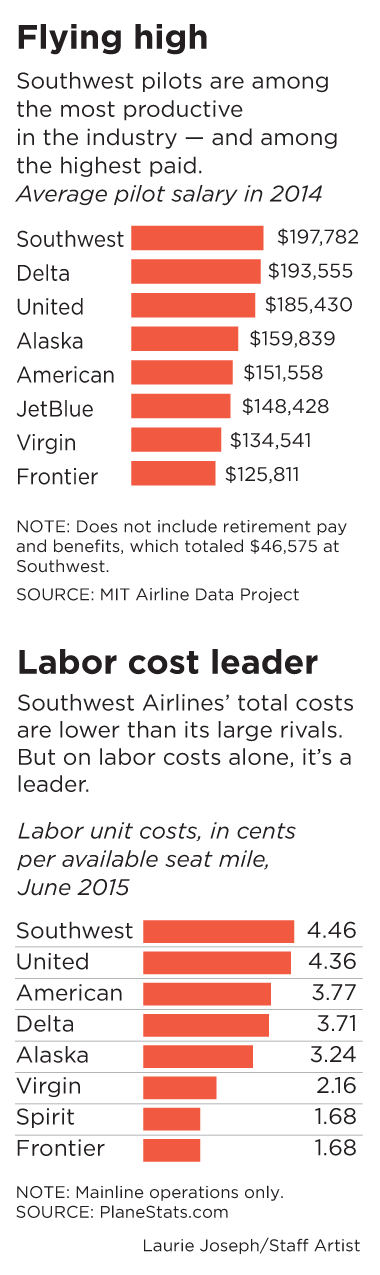
Southwest workers often are the highest-paid in the industry, but only when productivity and profit merit it. In 2014, Southwest pilots had the highest average salary in the business: almost $198,000, according to the MIT Airline Data Project.
 
But here’s something more impressive: “We’ve never had a layoff. We’ve never had a furlough. We’ve never had a pay cut. We’ve never cut benefits.”
 
That was Gary Kelly, Southwest CEO, speaking at a conference in December. And he was drawing a contrast between Southwest and the legacy airlines that were unable to withstand recessions, terrorism and other global events.
 
In the five years after 9/11, U.S. airlines eliminated 134,000 full-time jobs and steadily slashed pay and dropped pensions. Many carriers eventually went bankrupt. In 2000, seven airlines paid their pilots more than Southwest. By 2005, none did.
 
An analyst asked Kelly about his disappointment that pilots and flight attendants had soundly rejected tentative agreements last year. How would he get them to understand that Southwest’s low-fare brand is so crucial?
 
“We just have to make sure that we are rewarding our people in a way that also allows their company to remain strong,” Kelly said.
Southwest has never been stronger. It earned over $4 billion in operating profit last year, 85 percent more than 2014. Its market cap, near $23 billion, has tripled in three years.

Its annual profit streak now spans over four decades, and with fuel prices low and planes carrying record loads, money is pouring in.

Pilots, who’ve been negotiating a contract since 2012, want their share.
 
“We’re roughly 20 percent more productive, and we want to be rewarded for it,” said Jon Weaks, president of the Southwest Airlines Pilots’ Association and a company pilot since 1990. “We want to keep the company agile and competitive. But we’re not gonna work more and make the same” as other pilots.
 
Last fall, Southwest agreed to industry-leading pay on the pilots’ hourly rate, passing American’s 2015 contract figure by a nickel an hour, Weaks said.

(Since then, United has raised the bar further.) Southwest also agreed to lift the company match on retirement from 9.3 percent to 10 percent.
 
The tentative agreement reached last fall would have boosted pilot pay by 17.6 percent over the life of the contract, through 2019, the union said. Yet members rejected it almost 2-to-1 and then replaced the union leadership and negotiators.
 
There was disagreement over the value of back pay. But the retirement match is the big hang-up. At American and United, 16 percent of pay is put into retirement and pilots don’t have to contribute anything.
 
At Southwest, the match would have gone to 10 percent, and it’s contingent on pilots contributing a like amount.

Then Southwest kicks in a profit-sharing payment, a variable amount added to retirement. Historically, that’s been a healthy bump for Southwest employees.
 
In 2014, the profit share was 9.5 percent of pay, added to the company match. But in 2009, during the recession, Southwest profit-sharing was just 1.3 percent.
 
That spread provides a lot of flexibility for Southwest. If a much higher match were guaranteed, it would be that much tougher to cope with a fuel price spike or a contracting economy.
 
Southwest already faces a balancing act. In June, for the first time, its labor costs became the highest among U.S. carriers, said consultant Oliver Wyman. In two years, Southwest labor costs increased 16.4 percent, much more than any large rival, according to the firm’s report, Airline Economic Analysis.
 
Yet Southwest continues to have lower total costs. In June, it had an edge over Delta, American, United and JetBlue despite spending a higher amount on labor.

How does Southwest manage to have the highest labor expense and still lead many on total costs? Credit employee productivity and structural advantages, such as using a single plane type and secondary airports.

Kelleher used to say that preparing for bad times was prudent, because at least two crises would strike the industry every decade. So far, Southwest has been able to work through recessions and 9/11 without betraying employees. But if it locks in higher costs, what happens when the cycle turns?

The union chief said not to worry.

Demand for travel seems insatiable and airlines, post-consolidation, are disciplined about expansion, he said. And Southwest will keep finding ways to get more efficient, from adding modern planes to a new reservations system.

“This is not your father’s legacy carrier,” Weaks said.

If fixed costs get high enough, it’ll look like one.

( - The Dallas Morning News)

Wednesday, February 3, 2016

Boeing could make Super Hornets in India if purchased

Boeing F/A-18F Super Hornet "Rhino" (c/n F219) 166889 / 144 captured at NAF El Centro (NJK/KNJK) on January 28, 2016.
(Photo by Michael Carter)

Boeing says it could invest "billions of dollars" in India if Super Hornet sale materializes.

Boeing is in talks to manufacture its F/A-18 Super Hornet fighter jet in India as part of the country's Make In India initiative if it agrees to procure the aircraft.

Make In India is a government program launched by Prime Minister Narendra Modi, which aims to encourage multinational and domestic companies to invest in the country by building products there. Boeing CEO Dennis Muilenburg says building the fighter jet used by the U.S. Navy in India will be boon to the program.

"We see Super Hornet as an opportunity to do that to tie directly into the 'Make in India' strategy," Muilenburg told Hindustan Times in an interview.

The Super Hornet was considered as a replacement for the Indian Air Force's aging fleet, but lost to the Dassault Aviation-made Rafale in the procurement process. The $9 billion deal to procure 36 of the planes has been stalled over price negotiations, however, and Indian Defense Minister Manohar Parrikar has stated his government is open to other options.

"We think there is a great opportunity for us to bring Super Hornet to India that will fulfil an operational need, but even more importantly think about it as a capability investment and architect it as a broad industrial investment, build up a supply chain that has industrial capability, not only to design but also to manufacture for the full lifecycle of the products," Muilenburg said, noting the company was planning major investment in the country.

"Ultimately it will be measured in billions of dollars," he said. Boeing has yet to extend an official offer to build the planes in India, however.

"This is a conversation we are having with interested parties right now," Muilenburg said.

"It requires government-to-government agreement. It requires a customer here who makes a decision on projects it wants to pursue. In terms of our ability to execute on the project, to ramp up supply chain and skills base, that is something we can move up on fairly quickly," he said.

The F/A-18 Super Hornet is a twin-engine, multirole attack and fighter aircraft designed to takeoff from an aircraft carrier.

(Ryan Maass - UPI)

Boeing focuses on early 737 MAX delivery - CFO

Boeing said on Wednesday it was working to deliver its new 737 MAX single-aisle aircraft ahead of schedule next year, provided the company can complete testing on time and customers are ready to receive it.

"It's a little early to raise the victory flag at this point on early deliveries," Boeing Chief Financial Officer Greg Smith told an investor conference organized by Cowen and Co. "But we are focused on that. And if we can do it, and our customers can accommodate it, we will."

Boeing completed the first flight of the 737 MAX last week, raising the prospect that the updated version of its best-selling plane could be ready for delivery to its first airline customer, Southwest Airlines Co, earlier than the target of the third quarter of 2017.

Boeing is on track to lift production of its 737 Dreamliner to 12 a month this year and to increase the output of larger 787-9 aircraft towards 70 percent of the total, with 30 percent made up of smaller 787-8s, Smith said. The 787-9 is more profitable than the 787-8.

Smith said 2016 will be a "transition year" as Boeing delivers fewer 737 aircraft and cuts 747-8 production to six a year from 12 a year to account for flagging demand. Smith said Boeing will build up 737 MAX jets in inventory until the plane is certified in 2017, which allows it to deliver the planes to customers.

It also will build up inventory of 767 planes for delivery in 2017. His remarks reiterated points he and Chief Executive Dennis Muilenburg made last week in announcing fourth-quarter earnings.

Smith also said that Boeing sees continuing strong demand for aircraft despite low fuel prices, falling prices for used aircraft and weakening global growth that have raised concerns among investors that the aircraft cycle is peaking and helped send its stock down sharply last week.

Smith noted that Boeing's board recent authorized the company to return $14 billion in cash to shareholders in the next two or three years.
 
"We think we're significantly undervalued, especially right now, and considering the fundamentals of the backlog and the fundamentals of the business," Smith said.

(Reuters)

This Is Why No Airline Will Ever Dominate LAX

American and Delta would each like to be Los Angeles’s “hometown” airline, but LAX is a different bird.

It’s a battle for Los Angeles that may never have a clear winner.

American Airlines Group Inc. and Delta Air Lines Inc. are fighting to be the biggest airlines at Los Angeles International, the largest airport in one of the world’s most lucrative air travel markets.

Earlier this month, American said it will build two gates at LAX to allow 20 new daily flights, bringing its total to 220 flights and 70 destinations. It comes after Delta celebrated the completion last summer of a $229 million renovation of LAX’s Terminal 5, at which it operates, including a private entrance for celebrities and other elite travelers.

Delta says it has doubled its nonstop destinations from LA, to nearly 60 since 2012, and has doubled its seat count since 2009. With 15.4 percent of passenger share, Delta still trails American, which has 17.8 percent, as well as both United Continental Holdings Inc. and Southwest Airlines Co., according to the latest federal statistics.

“Right now it’s a race between us and Delta to be the biggest at LAX, but we feel good about our chances of winning that race,” said Doug Parker, American Airlines’ chief executive officer, on Jan. 13 in an employee newsletter. Almost 75 million passengers went through LAX in 2015, the second record set in as many years.

Despite the terminal renovations and flight expansions, it’s unlikely that LAX will ever be a true “fortress hub” like Atlanta (Delta), Dallas-Fort Worth (American), or Newark, N.J. (United), in which a single airline can command as much as 75 percent of the traffic.

For one thing, LAX isn’t the only game in town. It splits air traffic with four other airports within 55 miles, all with more than one airline offering service. An additional influential factor is how popular Los Angeles is as a tourist and business destination.

Most dominant hubs are skewed toward connecting service, with only about one-third of passengers starting or ending there, noted Andrew Nocella, American’s chief marketing officer. “In LA, you see almost the reverse,” he said.

This dynamic is also evident in such other major cities as New York and Washington, which haven’t evolved into dominant hubs. At Chicago O’Hare, United and American have hubs and split passenger share.


LAWA
Geography also plays a part. The fact that LAX is perched on the Pacific means it’s not as useful as a connection hub for east-west domestic flyers. Most of the connecting flows at LAX today are to and from Hawaii and Asia. “LA is just in a different set of circumstances,” Nocella said. “We’d like to go significantly higher, but we don’t anticipate LA would be a hub the size of a Dallas or Charlotte.”

Big airports also like to have as wide an array of airlines as possible to help stoke competition, curb fares, and expand destinations, said Michael Sikes, Southwest’s senior manager of network planning and performance. “If you’re an airport, I think you probably like a diversification of carriers.”
 
Delta and Los Angeles World Airports, the city department that manages LAX, recently signed a non-binding letter of intent to negotiate a lease for Delta to relocate to Terminals 2 and 3. A variety of international airlines use Terminal 2, while 3 is home to Frontier Airlines, JetBlue Airways Corp., Virgin America Airlines, Spirit Airlines Inc., and a few others.

American is spread among four terminals; any Delta relocation could be a catalyst for American to consolidate its far-flung real estate and improve passenger experience. Delta spokeswoman Elizabeth Wolf declined to comment further on the airline’s effort to relocate.

The other battlefront will be for corporate sponsorships, which can help secure business travelers and good publicity when celebrities are customers. American has signed up the Hollywood Bowl, the LA Clippers NBA team, Universal Music Group Inc., and others. Delta boasts the LA Lakers, the Grammy Awards, and the NHL’s LA Kings.

Even though LAX is unlikely to ever be a true airline hub, it has something even more important to carriers focused on landing high-value customers: Hollywood’s elite.

(Justin Bachma - Bloomberg Business News)

Monday, February 1, 2016

CargoLogicAir reveals fleet plans

(CargoLogicAir)

New UK-based all-cargo airline CargoLogicAir (CLA) has revealed it hopes to operate a fleet of five Boeing 747 freighters in 2018.
 
The much speculated-upon airline today confirmed it had been awarded an Air Operator Certificate (AOC) by the UK Civil Aviation Authority.
 
CLA has taken delivery of its first Boeing 747-400 freighter from Air Castle and will add a second 747F to its fleet in July 2016. CLA expects to have a fleet of five Boeing 747Fs by April 2018.

It said it would announce routes and an operations schedule in due course.

The Stansted-headquartered airline said it aimed to become a leader in the European air cargo market offering cargo services on scheduled and charter flights.

The airline aims to take a “strong position in the segment of all-cargo and outsize logistics solutions.”

Although many appointments were known due to LinkedIn profile updates, the airline also confirmed Dmitry Grishin, formerly vice president sales at Ruslan International, as its newly-appointed chief executive.

He is joined by Peter van de Pas in the role of chief operating officer & accountable manager, who previously held senior positions at KLM and Cargolux.

Steve Harvey is CLA’s chief commercial officer, having joined the airline from his previous post of regional charter sales manager EMEA of Atlas Air.
 
Grishin thanked all involved in the airline gaining its AOC and said: “Our aim now is to become a leader in the European air cargo market by earning a strong reputation for the highest levels of service, safety and efficiency.

“We believe that the all-cargo airline business model has its place on the market and that we can achieve sustainable growth by specialising in outsize and flexible solutions for our customers.

“We are open to cooperation with all who share the same passion for cargo as we do.
 
“We are also very grateful for the help we have received so far from partners such as Boeing, Stansted Airport and Aeropeople, who have supported us in building the company and its capabilities.” Harvey added: “We believe this is the right time to launch a new UK cargo airline.

“We created the company in the UK, which has a rich heritage of all-cargo specialist carriers including big names like HeavyLift, AirFoyle and others.

“The UK is the second largest air cargo market in the EU and its economy is growing. Using our knowledge, we plan to make a strong contribution to putting the UK back on the map of global all-cargo leaders.

“We have been extremely encouraged by the level of interest from our customers and expect this to result in us attracting the level of business we need to support our growth strategy over the next 3-5 years.”

Market speculation regarding the launch of the airline has been rife over the last few months, while the company itself did not want to talk to the press until it was ready for launch.

Video footage emerged of an aircraft in the livery of CargoLogicAir (see below) and a website emerged in November.
 
The website states that CLA aims to “become the leader in the European air cargo market offering cargo services on scheduled and charter flights, and with the freedom to explore growth opportunities with freight forwarders and other airlines that provide new opportunities for us and our customers.”
 
“Our team combines the highest levels of operational and commercial expertise, while our Boeing 747-400F with its 110 tonnes payload is one of the world’s most efficient and capable cargo aircraft,” it adds.
 
The website said that the airline will provide both schedule and charter services, with a network offering to customers extended to other major cities in Europe, North America and Asia Pacific through interline agreements and will be continually increased as partnerships are approved with other high quality cargo operators.
 
In January, flight tracking websites began to record the aircraft’s movements, with flights to Bari, Munich and Frankfurt being carried out.

A Companies House listing names Alexey Isaykin, Volga-Dnepr’s president, as the sole director of Cargo Logic Holding. In turn, CLA lists Cargo Logic Holding as its majority shareholder.

However, the airline stressed it is "an independent airline with its own executive and management team and fleet."

(AirCargo News)